Thursday, January 17, 2013

Patience, Child!


Bo
8 Shevat 5773 / Jan 18-19, 2013

In this week’s portion, Bo, we find plagues 8-10 (Locusts, Darkness, and Death of the Firstborn), and the Israelites being thrown out of Egypt, as the Egyptians couldn’t get rid of them fast enough after plague #10 (which killed every Egyptian first born man and beast – including Pharaoh’s eldest son).  We find a number of the requirements surrounding the holiday of Passover as well (such as eating unleavened bread and bitter herbs when commemorating the Exodus)

One of the most interesting pieces of the interactions we find between Pharaoh and Moses this week is that Moses actually warned Pharaoh that the 10th plague was coming – and specified what it was going to be!  Thus, before the plague struck, Pharaoh knew that the next plague supposedly was the death of the firstborn.  And after having seen 9 other plagues come to fruition, you’d think he might have been a bit more concerned (Granted we learn that his heart was being “hardened” by God, implying that his decisions were not necessarily his own…).

We also learn that after plague #8, Pharaoh actually said that all the Israelite men could leave Egypt; and after plague #9, that all of the Israelites could leave, but their flocks and herds must stay behind. 

I’m shocked that Moses wouldn’t have approached God to ask whether or not the Israelites should take one of the deals – especially the latter one.  Who cares about flocks and herds when freedom is on the line after hundreds of years of bondage?

The result, however, was that not only did the Israelites eventually leave with all of their flocks and herds, but with most of the gold and silver of Egypt as well, as they had been instructed to “borrow” gold and silver items from the Egyptians the night before leaving, and God supposedly created an environment in which the Egyptians were willing to lend them.

Evidently, for our ancestors, being patient clearly paid off. 

Patience is something many of us struggle with.  There is always something making us feel the need to fill silences with speech or to act and jump into something. Those who truly excel at being patient are those who consciously practice, and who are intentional about how they act – both horizontally (between people), and vertically (with the Divine).

Our tradition makes clear that patience is a Jewish virtue.  For example, in the Book of Proverbs (which is in the “Writings” section of the Hebrew Bible), we learn:

"The patient man shows much good sense, but the quick-tempered man displays folly at its height" (Proverbs 14:29), and

"A patient man is better than a warrior, and he who rules his temper is better than he who takes a city" (Proverbs 16:32).

This Shabbat, take a breath before responding to questions or comments made by others.  Recognize that first is not always best.  Acknowledge that just as our ancestors were patient enough to wait a bit longer after hundreds of years of bondage, the patience we’re capable of is immense.

Have patience with yourself.  Have patience with others.  And have patience with the Divine.

Friday, January 11, 2013

Don't be a Lemming...


Va’era
1 Shvat 5773 / January 11-12, 2013

In this week’s portion, Va’era, we find Moses and Aaron approaching Pharaoh, still asking him to allow the Israelites to go on a three-day journey into the wilderness in order to worship their God.

To help convince him to say yes, plagues #1-7 are brought upon Egypt.  As a result of a couple of them, Pharaoh is so concerned that he agrees to let the Israelites leave.  But, once Moses has the plague removed, Pharaoh’s heart hardens (sometimes on his own, sometimes as a result of God interfering and making it so), and he refuses to let the Israelites leave Egypt.

One of the most intriguing verses in this week’s portion comes at the very end, after Moses beseeches God at Pharaoh’s request to end the plague of hail (that had fireballs inside of it!). 

We read there: “And Pharaoh saw that the rain and the hail and the thunder had ceased, and he continued to sin, and his heart and the heart of his servants became hardened. (Ex. 9:34)

Knowing the story, we expect Pharaoh’s heart to be hardened.  After all, God told Moses ahead of time (in last week’s portion) that such would be the case.  However, what are we to make of the fact that Pharaoh’s servants also seem to be impacted in some fashion?

Some might argue that God, being all-powerful, also manipulated the free will of Pharaoh’s servants.  Others might argue that the servants were powerless to act any differently than their leader, as doing so might have put their own lives at risk.  I think that this verse provides a particularly valuable lesson as it relates to the perils that come with blindly following leaders.  

Pharaoh was a self-righteous jerk who didn’t have the best interests of the Egyptian people at heart.  He wouldn’t let the Israelites have a bit of a respite from their slave labor, and ultimately, the Egyptian people paid for his closed-mindedness.  By failing to disagree with (and organize against) their leader, Pharaohs servants were complicit in Egypt’s downfall, and arguably, were just as responsible.

Whether you’re a leader or contemporary “servant”:

When you see a wrong, speak out.

Don’t blindly follow anyone – always ask questions.

Stand up for what you know to be right.

Thursday, January 3, 2013

The Power of Introverts


Shmot
23 Tevet 5773 / Jan. 4-5, 2013

This week, we enter the Book of Exodus (book #2 of 5 in the Torah), and we find that a new Pharaoh has come to power in Egypt.  This new Pharaoh seems to have some issues with short term memory, as he has forgotten (ignored?) the good that Joseph did for Egypt, and in turn, enslaves the Israelites (he’s afraid that due to their birthrates, they’ll take over Egypt!).  He even goes so far as to decree that newborn Israelite males should be killed!

With this as our backdrop, we’re introduced to Judaism’s most cherished prophet, Moses.  As a newborn, Moses’s mother hid him for three months to keep him alive, and then proceeds to put him in a basket and floats him down the Nile.  Pharaoh’s daughter discovers the basket, decides the keep the baby, and Moses’s sister, Miriam, who was watching from afar, offers to go find a Hebrew wetnurse for the baby.  Pharaoh’s daughter accepts, and Miriam brings Moses’s mother – so, it’s Moses’s mother who actually nurses Moses as an infant!  Once weaned, Moses is brought back to Pharaoh’s daughter, and he is raised as a prince of Egypt.

One day, Moses finds an Egyptian mercilessly beating a Hebrew, and comes to the Hebrew’s defense, killing the Egyptian and hiding his body in the sand.  The next day, Moses learns that Pharaoh has found out and wants Moses dead; so Moses runs away.

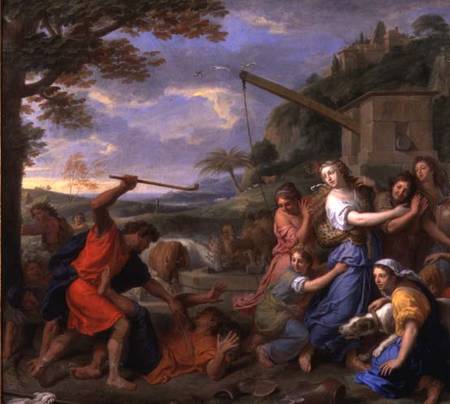
Moses camps beside a well in the town of Midian, and rises to the defense of  7 women (sisters!) who were being harassed and driven away from the well, and then waters their flocks for them.  What a gentleman!  It turns out that these young women are the daughters of the priest of Midian, named Jethro.  Since no good deed goes unrewarded, Moses is given the eldest of Jethro’s eldest daughter Tzipporah, as a wife, and shortly thereafter they have a son named Gershom.

At this point, we learn that the new Pharaoh (who didn’t “know” Joseph) died (he’d be replaced by another Pharaoh), and this is when the Torah tells us that God took notice of the cries of the Israelites.

God appears to Moses via the burning bush and says to him:  “I will send you to Pharaoh and you shall free my people.”

Moses replies: “Who am I that I should be your messenger?  What if they don’t believe me?”

God provides Moses with a few different miracles he can show off to the Israelites so that they’ll believe him. 

Moses still protests: “But I am slow of speech and slow of tongue.”

God angrily replies: “Your brother Aaron can be your mouthpiece.”

Aaron meets Moses and they perform the signs for the Israelites, who believe them.  They then approach Pharaoh for the first time and ask for the Israelites to be allowed to go on a 3 day journey into the wilderness to worship God (implying that they’d then return to Egypt – not quite “let my people go!”).

In response, Pharaoh punishes the Israelites by making them go get the straw they need to make bricks (it had been provided until this point) and demanding the same quota.  The Israelites are far from thrilled about this.

Moses questions why God would do this.

God responds: Just wait and see… He’ll let them go…

---

Moses, our greatest prophet, was an introvert.  And yet, despite lacking the desire to speak publicly, Moses constantly showed his willingness to stand up for others.  From striking down the Egyptian who was beating the Hebrew to standing up for Jethro’s daughters at the well, Moses revealed that there are times when even those who are self-proclaimed introverts can, must, and do act to help others.

I’ve always found it fascinating that our most heralded prophet was actually an introvert, given the Jewish tradition of talking (and having excessive opinions!).  Moses is beloved not for what he says, but rather for what he does.  My guess is that this does not surprise Susan Cain, a former corporate lawyer and negotiations consultant, as her Ted Talk from February of 2012 focuses specifically on The Power of Introverts (watch it – it’s awesome!).  Cain points to examples of leaders who reluctantly took the spotlight (e.g. Gandhi, Rosa Parks, Eleanor Roosevelt), even though “every bone in their bodies was telling them not to.”

Too often as a society, we ascribe value to those who are outspoken.  The reality, however, is that those who speak the loudest are not necessarily the ones who speak the best (or possess the most wisdom).  Moses often didn't even speak publicly at all -- rather, he used his brother Aaron as his mouthpiece.

This Shabbat, consciously wait a few seconds longer than you normally would before responding to questions or interjecting thoughts into a conversation.  Make the space to reflect and contemplate.  Recognize that just because someone is quiet, this doesn’t mean that s/he doesn’t have valuable insights to add to the conversation.  Make an effort to provide the space and comfort for individuals who are more introverted to share their thoughts as well (if they’d like to), as we’ll all be better off as a result.

Thursday, December 27, 2012

Little Brother


Vayechi
16 Tevet 5773 / Dec. 28-29, 2012

In this week’s portion we find Jacob, having lived in Egypt for 17 years, feeling his death coming on. After making Joseph promise to bury him back in Canaan with his ancestors, Jacob blesses Joseph’s sons, Menashe and Emphraim. However, instead of resting his right (dominant) hand on Menashe’s head (as Menashe was the elder brother and such was tradition), he rested it on Ephraim’s head. Joseph tries to correct him, but Jacob says his actions were purposeful, as Ephraim’s line would be greater than Menashe’s, despite Ephraim being the younger of the two.

As an eldest child myself, it’s very hard for me to admit that the story of the Jewish people has historically been that of the younger brother superseding the older brother: Isaac over Ishmael; Jacob over Esau; Ephraim over Menashe; and eventually, Moses over Aaron.

In many ways, what the Bible has done by consciously (and often painstakingly) pointing out the lineage of our ancestors is gift us with the underlying mentality that has allowed the Jewish people to survive for millennia. Namely, our narrative is the same as that often embodied by younger siblings striving to fill the shoes of their overachieving and (perceived) over-loved older siblings – that of the underdog. 

We are the miniscule pimply-faced David, facing the behemoth hyper-masculine Goliath. We are the Maccabees, few in number but strong in conviction. We are the tiny sliver of land in the Middle East surrounded by hateful neighbors.

As our ancestors did before us, we should embrace being the underdog, while acknowledging that embracing such a narrative inevitably may result in making it harder to recognize instances where we might occupy positions of relative power.

It is because of our underdog narrative, infused in us via our core religious text and embodied throughout history, that we find we possess the scrappiness we need to succeed in an ever-changing world, and the strength we need to face the Goliaths in our own lives.

Thursday, December 20, 2012

Take Me Instead


At the end of last week’s portion, we found Joseph threatening to enslave Benjamin for having “stolen” his goblet.

This week’s portion, Vayigash, begins with Judah, one of the brothers (who is where we get the term “Jewish” from – “Yehuda” = Judah and “Yehudi” = Jewish), interceding.  Judah, who promised his father Jacob that he would be responsible for Benjamin’s well-being, cries out to Joseph: “Take me instead!” believing that Jacob would die if the brothers returned without Benjamin.

Joseph is so moved by Judah’s gesture that he sends all his attendants out of his chambers, and yet they can still hear his cries through the door as he finally reveals who he is to his brothers.

Joseph shares with his brothers that it was God’s plan that events should transpire as they did so that Joseph could help save all of their lives.  With Pharaoh’s support, Jacob and his entire household were brought down to Egypt to settle in the area of Goshen, where their flocks would be able to thrive, and at last, Jacob reunites with Joseph, his favorite son.

This portion and some of the interactions within it are particularly resonant this week, in light of the mass murder at Sandy Hook Elementary School in Newtown, Connecticut that claimed the lives of 20 schoolchildren, 6 adults and the gunman.

So many of us in the aftermath of the news, like Judah, responded with the words, “Take me instead.”  Lord knows the parents of the children lost have said those words.  How many of us wouldn’t want to trade places with those who were so young and innocent… who still had so much promise and potential.  How many of us want to believe we would have acted the way the committed teachers and administrators who sacrificed their lives did – with bravery and valiance in the face of such blind and unhinged hatred.

It is near impossible to find any comfort in the notion that such actions, so inhumane and unbelievable, are part of God’s plan – a faith that Joseph expresses as his childhood dreams are fulfilled 20 years after he has them and he is put in a position of power to save himself and his family.  Could it really be that such actions are part of a broader plan, and that we simply cannot and may not ever understand what exactly that plan is?  Needless to say, the prospect is far from comforting.

At the end of this week’s portion, upon meeting Jacob, Pharaoh asks him a simple question: How many are the years of your life?
Jacob answers Pharaoh – that he has lived 130 years, and those years have not been easy – and that’s the end of their brief (and arguably awkward) interaction.

Like Jacob’s interaction with Pharaoh, the lives that were taken this past week in Newtown were much too brief, and their hypothetical answers to Pharaoh’s simple question would be heartbreaking.

This week, this Shabbat and every day thereafter, let us resolve to treat each day and each moment as precious.  Let us express our love and appreciation of others openly and without reservation.  Let us commit to bettering, and when necessary, overhauling existing systems in order to help those most in need and ensure our collective safety as best we can.  And let us have faith that while there are indeed events that strike us as unfathomable and unexplainable, that we, as human beings, have the power to shape the world as we see fit, and as Jews, must make it our business to do so.

Thursday, December 13, 2012

Clothes Make the Man


Miketz
2 Tevet 5773 / Dec. 14-15, 2012

In this week’s portion, Miketz, we learn that Pharaoh has a couple of dreams of his own.  After checking in with his court, Pharaoh’s butler remembers and mentions Joseph’s dream-interpreting skills.  Thus, Joseph gets a haircut, is put into some new clothes, and is brought before Pharaoh. 

Joseph interprets Pharaoh’s dreams to mean that there are seven years of plenty on their way, which will be followed by seven years of famine.  He suggests that Pharaoh set someone in charge of conserving resources and planning over the seven years ahead to ensure there is enough to eat in the seven years of famine.  Lo and behold, Pharaoh makes Joseph his #2 and charges him with designing and executing such plans, and gives him an Egyptian wife, who in turn births two sons: Menashe and Ephraim.

After the seven years of plenty, famine strikes throughout the world, and Jacob sends his 10 older sons (he keeps Benjamin, his new favorite, and the youngest, at home) to Egypt to procure food.  Upon arriving in Egypt, Joseph recognizes his brothers (but they do not recognize him), and decides to give them a bit of payback.  He accuses them of being spies, and imprisons them for 3 days.  He then sends all but Simeon home, saying that he doesn’t want to see them again unless Benjamin is with them.  His brothers wail amongst themselves that this misfortune has come upon them because of what they did to their brother Joseph, not knowing that Joseph understood them, because there was an interpreter between him and them. 

Upon returning home, Jacob is unwilling to allow Benjamin to leave – even with Reuben promising that he’ll be looked after.  Thus, the brothers stay at home until their food runs low again (leaving Simeon in jail).  Then, Jacob accedes to the demand to send Benjamin, recognizing that they would all die without food.  Upon returning to Egypt, the brothers are treated well, with special favoritism shown by Joseph to Benjamin (perhaps trying to discover whether his brothers were still the jealous fratricidal types). 

Upon sending them home, Joseph has a goblet put in Benjamin’s sack.  He has his guards chase after the brothers, overtake them, and “discover” the “theft.”  The portion ends with the brothers offering themselves as slaves to Joseph, who states that he only desires as a prisoner “the one in whose possession the goblet was found.”

One of the most interesting sections of this portion, to me, is what takes place when Joseph is brought out of prison to interpret Pharaoh’s dreams.  Before being brought to Pharaoh, Joseph was cleaned up! Between a haircut and some fresh clothes, Joseph must have looked like a new person when juxtaposed with his previous “prison chic” look.  It’s quite possible, and even likely, that by virtue of appearing clean and well dressed, that Pharaoh paid more attention to Joseph and attributed to him greater wisdom than he otherwise would have.

Mark Twain once stated: “Clothes make the man. Naked people have little or no influence on society.”

It’s no secret that clothes and appearance have a significant impact on how we view others.  While we like to think that we can look past exterior superficialities, we judge people all the time based on their external appearances.  One of the areas in particular where this is the case is when interviewing for jobs.  Even jobs that don’t require workers to dress formally at work often require applicants to dress in a more formal manner when interviewing.  The reality is that many people do not have the means to own such formal items.

While every season should be a season of giving, the holiday season in particular (partially due to year-end tax write-off possibilities) is one where many folks are conscious of giving a little bit extra.  This holiday season, consider donating lightly used or new professional wear to organizations such as Dress For Success and Career Gear – organizations focused on helping individuals find lasting employment by offering various tools, including appropriate interview attire.

According to Maimonides, the medieval Rabbi and philosopher, helping others find work is the highest rung on the ladder of charitable giving. 

This holiday season, let’s strive to look past each person’s external features and to recognize internal beauty.  Let’s reconcile any outstanding issues we may have with our own families, as Joseph struggled to do with his brothers.  And let’s climb to the highest rung of charity -- helping others make a living -- by assisting them in acquiring the tools (and clothing) they need to do so. 

Friday, December 7, 2012

I Dreamed a Dream


Vayeshev
24 Kislev 5773 / Dec. 7-8, 2012

In this week’s portion, we get to know Jacob’s sons.  Jacob, like his father before him, played favorites, designating Joseph as his favorite son (due to being the first son born to Jacob’s favorite wife, Rachel).  As one might expect, Joseph’s brothers were quite resentful of this favoritism, and such resentment only grew when Jacob gave Joseph an ornamented tunic (“coat of many colors”).

Joseph played into this favoritism in many ways, and frankly couldn’t figure out that sometimes, not everything needs to be shared with others.

Prime example: Joseph had two dreams; one which symbolized his brothers bowing to him, and the second symbolizing not only his brothers bowing to him, but his mother and father bowing to him as well.  Joseph decided he would share these dreams with his brothers, who hated him even more for suggesting they would one day bow to him, and with his father, who was quite troubled by his son’s dreams as well.

One day, Jacob sent Joseph to check in on his brothers, who were shepherding.  His brothers saw him coming and conspired to kill him, saying, “Here comes that dreamer…” If not for Reuben, who intervened, Joseph’s brothers likely would have killed him on the spot.  Instead, Joseph had his tunic ripped from his shoulders and was sold into slavery, eventually ending up in the house of a prominent Egyptian named Potiphar (who had a very demanding spouse…).  After refusing the advances of Potiphar’s wife, and after her accompanying tale suggesting that he had tried to force himself upon her, Joseph ends up in jail, where he has the opportunity to interpret the dreams of Pharaoh’s Cupbearer and Baker respectively.  Joseph’s dream predictions turn out to be true, with the Baker being hanged, and the Cupbearer being restored to his position (and forgetting his promise to Joseph to let Pharaoh know that Joseph was awesome and should be let out of jail).

One of the constant themes throughout the Joseph saga is the power and purpose of dreams.  Joseph has dreams of his own that we know later on turned out to be (mostly) true.  His fratricidal brothers refer him to as “the dreamer.”  He later comes to correctly interpret the dreams of Pharaoh’s Cupbearer and Pharaoh’s Baker. 

What does Judaism have to say about dreams? 

Are dreams a reflection of our desires? 
Are they simply reminders of what we were thinking about right before we went to sleep?
Do they foretell our future?

The ancient rabbis had much to say about dreaming, often using the Joseph story as their basis.

For example, we learn in the Talmud that all dreams follow their interpretation (interpreting dreams was a big deal in those days, as we also learn that “a dream that is not interpreted is like a letter that is not read”); that it might be better to have a negative dream than a positive one, as the negative dream will hopefully cause the dreamer to repent for his sins; that even those dreams that seem to tell the future are not completely realized, which we learn from the fact that Joseph dreamed his mother would bow to him as well as his father and brothers, but that didn’t happen because she died before having the chance to do so; and that it may take a long time for a dream’s prediction to come to pass, as evidenced by Joseph having to wait 22 years between his dreams of his siblings bowing to him and their appearance before him in Pharaoh’s court.
[Bab. Talmud, Berachot 55]

We are also taught that one should fast after having a bad dream (fasting is not just for Yom Kippur in the Jewish tradition!).
[Bab. Talmud, Shabbat 11]

What are we to make of these teachings about dreams?  (there are many more as well!)

The ancient rabbis believed that by putting dreams into words (having them interpreted), one essentially opened the door for said dreams to actually come to fruition.  In essence, putting into words what your subconscious had seen was viewed as a mechanism for realization.  What a powerful concept! 

In contemporary spoken English, we often use the word “dream” when what we really mean is “aspiration that is just out of reach.”  For example, “I dream of being an NBA basketball player,” or “I dream that one day my children will not be judged by the color of their skin, but rather by the content of their character.” 

What I would argue is the essential takeaway point Joseph’s dream saga and the accompanying wisdom of the ancient rabbis is that the first step towards achieving one’s aspirations is putting one’s dreams into words – in effect, putting the vision out into the world. 

To sum up, in rhyme:

Whether or not dreams come true, is entirely up to you.

Only by actively articulating what we hope to see, can we focus on taking the steps necessary to making our dreams reality.