Friday, November 2, 2012

When You're Smiling...


Vayera
18 Cheshvan 5773 / November 2-3, 2012
 
At the beginning of this week’s portion, Vayera, we find God visiting Abraham to check on him after his recent circumcision (which at age 99, was likely taking its toll physically).  Modeling for us the Jewish value of bikkur cholim -- visiting those who are ill -- you’d think that Abraham would have been flattered that God was stopping by to hang out for a bit.  Instead though, what we find is one of the more interesting interactions in the Torah.  Just as God was visiting Abraham, Abraham looked up and saw three men passing by.  Abraham rushes out of his tent to them (leaving God behind!) in order to greet them and to offer them food and shelter as a respite from their journey.

What. Just. Happened.?!

Abraham, our patriarch, supposedly the founder of monotheism, is being visited by his one and only God, and abandons God in favor of greeting complete strangers.

Is this simply a case of excessive hospitality?

There is a midrash that teaches us that Abraham's tent was consciously kept open so that he could see visitors coming in order to greet them in this fashion. [Genesis Rabbah 48:9]

In the Talmud, we see Abraham’s actions used to illustrate a general (and significant) principle: “Rabbi Yehuda said in the name of Rav: Welcoming guests is greater than receiving the Divine.” [Bab. Talmud Shabbat 127b]

Clearly we can learn from this episode the significant value that our tradition places on welcoming guests – including (especially?) ones that we don’t have existing relationships with.

Where does this notion of excessive hospitality play out in our tradition?

As an example, on Passover, there’s a part of the Seder (the paragraph of “Ha Lachma”) where we say: “Let all who are hungry come and eat!”  Many families will actually open the door to their home at this time and shout it to the street so that anyone passing by in need of a Seder will be able to come and join (granted, this model might have been more practical in Old Country where folks were living in closer, tighter quarters, although there’s certainly an argument to be made that in big cities with dense populations the ability still exists).

And yet, despite our people’s strong tradition of being welcoming, there are many who find today’s Jewish community to be cold and distant, rather than warm and present.  People often will walk into synagogues and not be greeted warmly, if they’re greeted at all.  Individuals will make charitable contributions to Jewish organizations they previously have had no relationship with, and will not receive a personal phone call expressing appreciation – rather, they’ll only receive a form letter in the mail for tax purposes.  Someone new will move to town, won’t be invited to join existing social circles, and/or won’t be invited over to someone’s home for a Shabbat dinner shortly after arriving so that s/he can meet others.

We can and need to do better.  Our tradition and accompanying values demand it.

This Shabbat, reflect on what you can do to be more welcoming of others.

Commit to reaching out to someone you know is new to the area and invite him/her to your home for a meal.

We learn from Shammai in Pirkei Avot, the section of the Mishnah dealing with the Ethics of our Ancestors, that we should “receive everyone with a cheerful face.” [Avot 1:15]

Sometimes all it takes to be welcoming, and to change someone else's world, is a smile.

Friday, October 26, 2012

Rescue Me!


Lech Lecha
11 Cheshvan 5773 / October 26-27, 2012


In this week’s portion, Lech Lecha, we find Abram (his name was changed later to Abraham!) being instructed by God to leave his native land, and to journey “to the land that I will show you.”  Abram brings his wife, Sarai (name changed later to Sarah), his nephew, Lot, and their collective households (think: cattle, slaves, etc. -- they were pretty wealthy folks).

After a brief trip to Egypt due to famine where Abram lies about Sarai being his wife by having her agree to pretend that she is actually his sister in order to save his life (she was quite attractive, and Abram was afraid he’d be killed if the Egyptians knew he was her husband), Abram and Lot finally reached a massive open area and needed to decide where they would settle with their respective flocks (they couldn’t settle in the location because their flocks were too numerous to be contained in the same space).  Abram let Lot choose where to settle, and Lot chose the more fertile land, near Sodom.

It seems that no selfish act goes unpunished, as shortly after settling in, Lot is captured by rival kings who conquered the land where he lived.  Upon hearing this, Abram called all the members of his estate to arms, and they went, battled, and freed Lot from captivity.

What does it mean to put your life and property at risk in order to rescue another?

Who in your life would you make such a potential sacrifice for?

As Jews, we have a bit too much experience with needing to be rescued.  Our history is littered with examples of others taking advantage of us and making us prisoners.  While at times others would take personal risks in order to save us, unfortunately mass mobilizations making rescuing us a priority didn’t frequently materialize.

More recently, Jewish resources and resourcefulness in the United States and autonomy in Israel have allowed for Jews to play an active role in rescuing other Jews when necessary.  See, for example, the work done with Soviet Jewry and Ethiopian Jewry. 

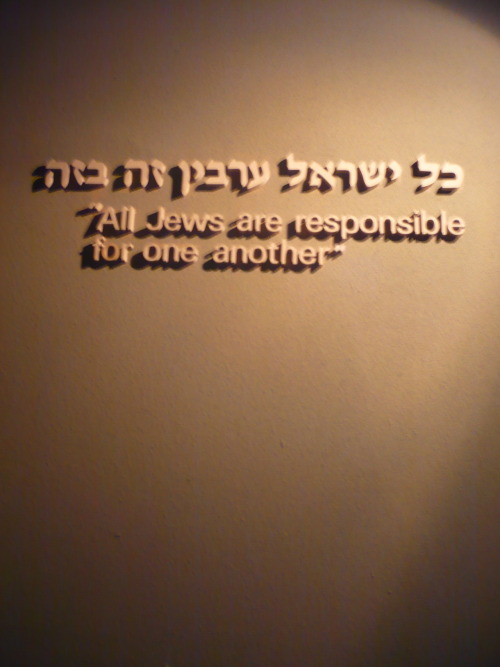
We learn in the Talmud (Shevuot 39a): "Kol Yisrael arevim zeh bazeh” – all Jews are responsible for one another.

What are we to make of this charge of responsibility? 

Many of us wouldn’t take the risk that Abram took for our own family members – let alone strangers who happen to share a common heritage.

Can we truly strive to work towards the wellbeing of Jews around the world that we don’t even know?

Nineteenth Century Jewish American poet Emma Lazarus (whose work can be found on the Statue of Liberty) may have said it best: “None of us is free until we are all free.”

This Shabbat, reflect on what it is to uproot and leave your home, as Abraham (then called Abram) did. 

Compare this with being trapped – imprisoned – and not being permitted to leave, as so many of our Jewish (and non-Jewish) brethren have had to deal with throughout history.

Resolve to be conscious of freedoms being denied to others.  Be ready to act.  Be ready to sacrifice.  Because our perceived freedom is meaningless if others aren’t being permitted to partake of it.

Friday, October 19, 2012

Oh Noah You Didn't!


Noach
4 Cheshvan 5773 / October 19-20, 2012

In this week’s portion, Noach, we find the well-known story of Noah’s Ark (“Noach” is the Hebrew pronunciation of the name “Noah”).  We learn that “Noah was a righteous man; blameless in his age.”  At God’s command, Noah built an ark, brought in male and female of every species on earth, and also stored enough food on the ark to last for an extended period of time.  After 40 days and 40 nights of rain, as well as an extended period of time for the waters to subside, Noah, his family, and the animals in the ark eventually are able to walk the earth (and procreate in order to populate it) again, and God makes a covenant (symbolized by a rainbow) with humankind, that never again will the world be flooded in a such a manner.

As a fun fact, it is at this point in the Torah that we find humankind being given permission to eat animals:  “Every creature that lives shall be yours to eat.” [Genesis 9:3]  Notice the reference in the verse above is to every creature – kosher laws didn’t come until much later!

We learn in this week’s portion that after the flood, Noah planted a vineyard.  After making wine (I hear 2300 B.C.E. was an excellent vintage!), Noah got so drunk that he passed out naked in his tent.  One of his three sons approached him while he was naked without shielding his eyes (and was subsequently punished to serve his brothers), while his other two sons shielded their eyes and covered their father’s nakedness. 

Judaism and alcohol have a complicated relationship.

In the Bible, wine is described as bringing joy both to God and man. [Judges 9:13]

As Jews, we regularly use alcohol in our celebrations.  Wine is part of our wedding ceremony, our circumcision ritual, and our Shabbat / Havdallah rituals.  In fact, there are even times when we’re meant to drink a little bit to excess – for example, it is customary to drink 4 cups of wine on Passover (granted, those cups are spaced out over a long Passover Seder), and for some it is a tradition on Purim to have a couple of drinks.  Wine in particular was so ingrained into Jewish culture that the Talmud actually assumes that wine was drunk with dinner! [see Bab Talmud Shabbat 10a]

However, the Torah and Midrash also contain many examples of wine being a negative influence.  When Noah passed out drunk, his son ended up punished.  When Lot drank too much, his daughters seduced him.  When Nadav and Avihu, sons of Aaron the High Priest, made an alien fire offering before God while drunk, they were struck down on the spot.

While Jews are traditionally required to pray three times per day, we learn in the Talmud that one cannot pray while drunk:
“Rabbah bar Rav Hunah taught: One who is drunk may not say prayers; and if he does pray, this prayer amounts to an abomination.” [Eruvin 64a]

Thus it appears that while there is a strong tradition of drinking with joy, we also find that we are meant to limit our consumption so that we don’t hit a state of drunkenness.

Rarely does drunkenness impact only the person drinking.  In this week’s portion, we find that when Noah passed out drunk, it resulted in one of his sons being cursed.  In a more contemporary situation, many people drink and drive without being cognizant of the fact that it’s not only their own lives they are putting at risk, but the lives of everyone else on (or near) the road as well.

As it relates to alcohol (and much of life in general), Judaism effectively preaches moderation.  Be joyful, but not so joyful that it results in pain and shame, for you or to others.

May the Shabbat ahead be one filled with joy, where we bask in the beauty of rainbows reflecting God’s covenant with humankind to never again flood the world (it has been raining here in Detroit!), where we savor our day of rest, and where we maybe partake of a l’chayim or two as well.Noach
4 Cheshvan 5773 / October 19-20, 2012

In this week’s portion, Noach, we find the well-known story of Noah’s Ark (“Noach” is the Hebrew pronunciation of the name “Noah”).  We learn that “Noah was a righteous man; blameless in his age.”  At God’s command, Noah built an ark, brought in male and female of every species on earth, and also stored enough food on the ark to last for an extended period of time.  After 40 days and 40 nights of rain, as well as an extended period of time for the waters to subside, Noah, his family, and the animals in the ark eventually are able to walk the earth (and procreate in order to populate it) again, and God makes a covenant (symbolized by a rainbow) with humankind, that never again will the world be flooded in a such a manner.

As a fun fact, it is at this point in the Torah that we find humankind being given permission to eat animals:  “Every creature that lives shall be yours to eat.” [Genesis 9:3]  Notice the reference in the verse above is to every creature – kosher laws didn’t come until much later!

We learn in this week’s portion that after the flood, Noah planted a vineyard.  After making wine (I hear 2300 B.C.E. was an excellent vintage!), Noah got so drunk that he passed out naked in his tent.  One of his three sons approached him while he was naked without shielding his eyes (and was subsequently punished to serve his brothers), while his other two sons shielded their eyes and covered their father’s nakedness. 

Judaism and alcohol have a complicated relationship.

In the Bible, wine is described as bringing joy both to God and man. [Judges 9:13]

As Jews, we regularly use alcohol in our celebrations.  Wine is part of our wedding ceremony, our circumcision ritual, and our Shabbat / Havdallah rituals.  In fact, there are even times when we’re meant to drink a little bit to excess – for example, it is customary to drink 4 cups of wine on Passover (granted, those cups are spaced out over a long Passover Seder), and for some it is a tradition on Purim to have a couple of drinks.  Wine in particular was so ingrained into Jewish culture that the Talmud actually assumes that wine was drunk with dinner! [see Bab Talmud Shabbat 10a]

However, the Torah and Midrash also contain many examples of wine being a negative influence.  When Noah passed out drunk, his son ended up punished.  When Lot drank too much, his daughters seduced him.  When Nadav and Avihu, sons of Aaron the High Priest, made an alien fire offering before God while drunk, they were struck down on the spot.

While Jews are traditionally required to pray three times per day, we learn in the Talmud that one cannot pray while drunk:
“Rabbah bar Rav Hunah taught: One who is drunk may not say prayers; and if he does pray, this prayer amounts to an abomination.” [Eruvin 64a]

Thus it appears that while there is a strong tradition of drinking with joy, we also find that we are meant to limit our consumption so that we don’t hit a state of drunkenness.

Rarely does drunkenness impact only the person drinking.  In this week’s portion, we find that when Noah passed out drunk, it resulted in one of his sons being cursed.  In a more contemporary situation, many people drink and drive without being cognizant of the fact that it’s not only their own lives they are putting at risk, but the lives of everyone else on (or near) the road as well.

As it relates to alcohol (and much of life in general), Judaism effectively preaches moderation.  Be joyful, but not so joyful that it results in pain and shame, for you or to others.

May the Shabbat ahead be one filled with joy, where we bask in the beauty of rainbows reflecting God’s covenant with humankind to never again flood the world (it has been raining here in Detroit!), where we savor our day of rest, and where we maybe partake of a l’chayim or two as well.

Friday, October 12, 2012

Here We Go Again


Bereshit
27 Tishrei 5773 / Oct. 12-13, 2012

We begin the Torah again this Shabbat by reading the first portion, Bereshit.  In addition to the traditional Jewish view of how the world and humankind were created (note that there are actually two different creation stories in Genesis 1 and Genesis 2 respectively – in one of them, Adam and Eve are created simultaneously, and in the other, Eve is fashioned out of Adam’s rib), we find the earliest case of sibling rivalry – that of Cain and Abel. 

The Torah states that Abel was a shepherd while Cain worked the land, and that after a period of time, each brought an offering before God, who partook of Abel’s offering, but not Cain’s.  As a result, Cain was distressed and killed his brother Abel.  When confronted by God, who asked Cain if he knew where Abel was, Cain responded with the famous line: “I don’t know.  Am I my brother’s keeper?” [Genesis 4:9]

Both theologians and secular philosophers have long struggled with this very simple question.  As human beings, do we owe some sort of duty to one another?

To what extent are we meant to be keepers of our families? 

Of our friends? 

Of the people of the Jewish community at large? 

Of the people of the world at large?

The Jewish tradition makes it clear that we absolutely, 100%, owe a duty to other human beings. 

For example, the Torah creates protected classes of people:

You shall not ill-treat any widow or orphan.  If you do mistreat them, I will heed their cry as soon as they cry out to Me, and My anger shall blaze forth and I will put you to the sword, and your own wives shall become widows and your children orphans.” -[Exodus 22:21-3]

In addition to consciously treating widows and orphans well, lest we suffer Divine wrath, our tradition actually mandates that we love our neighbors as ourselves:

You shall not take vengeance or bear a grudge against your kinsfolk. Love your neighbor as yourself: I am the Lord.” - [Leviticus 19:18]

Rabbi Akiva, one of our greatest sages, is attributed as having said [in the Jerusalem Talmud, tractate Nedarim, page 30] that “Love your neighbor as yourself” is the most important rule in the entire Torah!

Now admittedly, things could get a bit tricky if we were truly charged with loving everyone else the way we love ourselves.  What would this mean for the sharing of sparse resources, for example?  Are we simply meant to share everything we have with everyone else in need?

Maimonides (AKA the “Rambam”), the prominent medieval rabbi and philosopher, outlined eight different types of charitable giving, and organized them hierarchically.  The top and best form of charitable giving, according to Maimonides, is to actually provide someone (or help someone acquire) a job.  While this may not initially seem like charity in the sense that we contemporarily understand it, it’s impact is similar to the adage of giving someone a fish so s/he can eat for a day as being less valuable than teaching someone to fish so that s/he can eat for a lifetime.

As Jews, our tradition makes clear that we owe a duty to our fellow human beings.  We are indeed required to be our brothers’ keepers.  We are charged with protecting those who need protecting, loving others as we do ourselves, and finding meaningful and impactful ways of enhancing the lives of those around us with our charitable endeavors.  

What better message could there be as we start reading the Torah again from the very beginning?

Thursday, October 4, 2012

Life Is All About Cheesecake


V’zot HaBeracha

We’ve reached the final portion of the Torah – V’zot HaBeracha.  On the holiday of Simchat Torah, next Monday night and Tuesday, we read this portion, and immediately following, we read a section of the portion of Bereshit – the first portion of the Torah – in order to symbolize the never ending nature of our learning.  In V’zot HaBeracha, Moses offers a blessing to the Israelites before his death, as they prepare to cross the Jordan River and enter the Promised Land, without him, under the leadership of Joshua. 

Upon concluding his blessing, we learn that Moses ascended a mountain, looked out over the Promised Land that he was not permitted to enter, and passed away.  The portion tells us that it was God who buried Moses, and that as a result, no one knows exactly where he was buried.  We also learn that Moses was 120 years old when he died (one of the reason’s it’s customary to shout out “’ad me’ah v’esrim!’ – ‘until one hundred and twenty!’” at Jewish birthday celebrations).  We learn that the Israelites mourned Moses for 30 days, and we find the quote in the header above – that “never again did there arise in Israel a prophet like Moses…”

What is it to live 120 years?

Is it quantity or quality that counts?

Many of us have been to a buffet where we remark, “I actually don’t need a buffet – I’d rather have less and have it be of a higher quality.”  Even if we don’t say it at the time, a couple hours later we usually get to that point.

How do we live lives of meaning and purpose, regardless of how long we’re here for?

I know some people in their late eighties and nineties who are dieting.  At some point, doesn’t it become okay to eat cheesecake whenever you want?

Are there Jewish secrets to living a long life?

While our tradition doesn’t necessary have much to say about Omega-3 fatty acids or Acai berries, the ancient rabbis had much to say about what sorts of foods one might choose to eat in order to live a healthy and long life:

“Leeks are harmful for the teeth and beneficial for the intestines.”
“Cabbage is for sustenance and beets are for healing.”
“Woe to the belly through which turnips pass.”
[Berachot 44b]

Others looked to non-dietary matters as playing a part in living a long life.  For example, Rabbi Hillel taught: “One who increases Torah, increases life.” [Avot 2:8]

Similarly, we learn in the Talmud: “Rav Yehuda said: There are three things that if prolonged, prolong the years of a person: one who spends a long time praying, one who spends a long time at his dining room table, and one who spends a long time in the restroom.” [Berachot 54a]  (Don’t worry – the ancient rabbis explain these three things in a bit more detail in order to make them seem a bit more holy).

However, it’s not just about quantity.  Certainly, quantity is nice and can be a blessing; but I would argue that quality plays an even more essential role.  To live a long life, but in doing so, to have never truly LIVED is not in step with our tradition.  While we’re taught to remember that even in our moments of greatest joy, there are others who are not as fortunate as we are (e.g. stomping on a glass at the close of a Jewish wedding; putting salt on the challah on Friday night), traditional Jewish wisdom encourages us to live, and to live joyously. 

We are instructed to rejoice in the Sabbath.  [Isaiah 58:13]

We are instructed to rejoice in our festivals. [Deuteronomy 16:14-15]

We are instructed to be joyous when we pray.  [Psalms 100:2]

A huge portion of our tradition deals with the quality and joy we experience in life!  To focus solely on longevity and to ignore life’s moments is to ignore the very essence of what it is to live a Jewish life.

Hopefully, we will all warrant long lives, with longevity rivaling Moses’s 120 years.  Yet, we must admit, longevity is often out of our control.  What we can control is how we fill the days we’re blessed enough to have.

Cherish each day. 

Take nothing for granted.

Eat cheesecake.

Strive to make sure that your life is lived with joy, with love, and with purpose.